For an Alabama Educator, a Job Done Too Well?
Superintendent Heath Grimes won national recognition for serving Russellville’s growing Hispanic student body. Then the district showed him the door.

;)
Education news and commentary, delivered right to your inbox.
Sign up for ÉçÇøºÚÁÏ newsletter.
Get stories like this delivered straight to your inbox. Sign up for ÉçÇøºÚÁÏ Newsletter
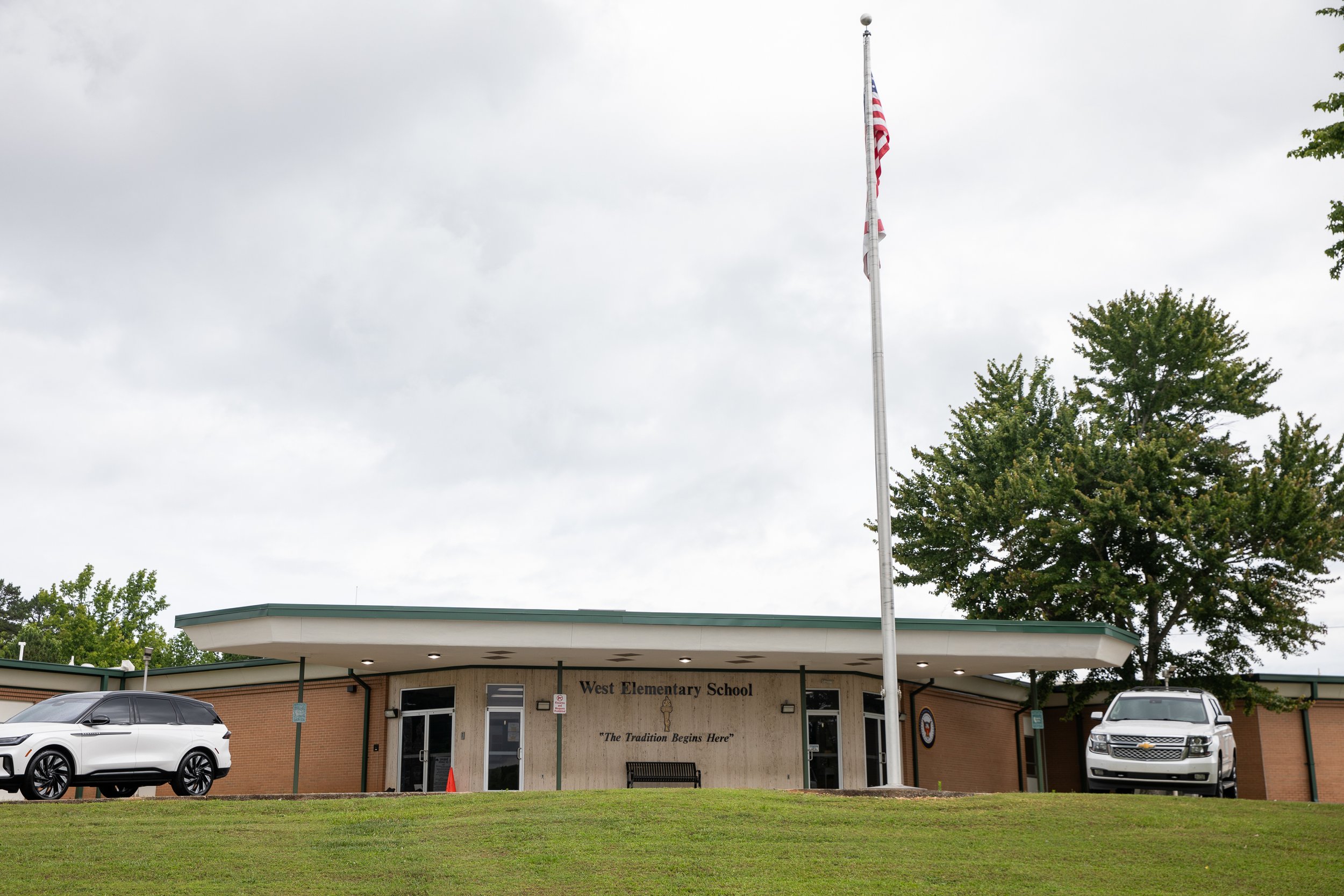
RUSSELLVILLE, Ala. — Lindsey Johnson and Yesenia De La Rosa were taking different approaches to teaching the same English lesson on silent letters as they sat at opposite ends of this first grade classroom in West Elementary School. On this March afternoon, Johnson, the classroom teacher, was reading a story with the 6- and 7-year-old children who were fluent in English. The students of bilingual aide De La Rosa were still learning the language, so while she read the same story, she went slower, translating words, acting out emotions and showing them pictures on her iPhone.
Valentina, 6, wearing a black T-shirt with a gold Nike logo and leggings, had arrived less than two weeks earlier from Guatemala. She sat on the floor near De La Rosa’s chair, her cheek almost touching her teacher’s leg. De La Rosa worked with her individually because she didn’t know any letters or numbers, in Spanish or in English. When Valentina went to kindergarten in her home country, all she did was color. “So when she came here, that’s what she thought she was going to do. Just drawing,” De La Rosa said. “But here it’s different.”
The Russellville City school district created De La Rosa’s position in early 2021 as part of a larger effort to help educate its growing population of students who speak English as a second language. Many of the English learners, as they’re called, have parents from Mexico or Guatemala who work at a nearby poultry plant and in local manufacturing and construction jobs. Today, in the district, 60% of children are Hispanic/Latino and roughly a third are English learners.
Without De La Rosa, Johnson said she wouldn’t be able to communicate with more than half of her students, or understand the challenges they face. Johnson knew that Yeferson, an English learner from Guatemala, was one of the smartest children in the class, already reading more than 100 words, well above the goal of 60. “He’s a sponge, he soaks everything up,” Johnson said. She learned from De La Rosa that he’s doing well in spite of his many responsibilities at home: His mom works night shifts, so Yeferson does the laundry, washes the dishes and looks after his younger siblings. Said Johnson: “Having a bilingual aide makes a world of difference.”
‘Heath Grimes put students first. And this ultimately may have hurt him.’
Russellville may not seem like a community that would be home to investment and innovation for immigrant students. It’s a politically conservative city in northwestern Alabama of about 11,000, where 72% of voters chose Donald Trump in the last presidential election. When the poultry processing plant opened in 1989, the Latino population was about 0.5%. By 2000, it had grown to 13%, and in 2020, it was almost 40%. The school district, like many around the country, struggled early on to accommodate the rising numbers of English learners, who were dropping out at high rates, being pushed into special education classes and showing little academic progress. Yet their success matters: Today in the U.S., are English learners and, at a time when overall public school enrollment is falling, they are among the country’s fastest-growing groups of students.
In early 2015, when its superintendent announced his retirement, the district recruited Heath Grimes, then superintendent of the nearby Lawrence County school system, for the job. A self-described Southern conservative and man of faith from rural Alabama, Grimes, 48, set about overhauling instruction for English learners, establishing culturally relevant extracurriculars and reaching out to the Latino community. Those efforts had an impact: The share of Latino students taking Advanced Placement classes and dual enrollment courses at a local community college went up. Parental involvement increased. And Grimes led an effort to lobby lawmakers for a change in the state funding formula for English learners, boosting the state’s allocation more than eightfold, to $18.5 million. The district and Grimes won state and national recognition for their efforts with English learners.

“Any district with a significant English learner population has looked to Heath because he’s been ahead of the game,” said Ryan Hollingsworth, the executive director of the School Superintendents of Alabama, which represents the state’s 150 school districts. “It is just amazing to see what he’s been able to do in a small district with not a lot of resources.”
But as Grimes’ star rose statewide, according to local educators and residents, his relationship with city leadership started to unravel. Then, in mid-May 2023, a member of the school board told Grimes that it would not be renewing his contract, which was to end in June 2024. He agreed to retire when his contract ended the following year in exchange for a bump in his final year’s salary. Starting in November, I tried to talk with school board members, the mayor and City Council members about the school district and Grimes, but they did not respond initially to my interview requests. (When I introduced myself to the mayor, David Grissom, on the street in Russellville, he told me “no comment” and walked away.) But over the months, I was able to talk to more than 60 state officials, local administrators, teachers, former school board members, community leaders and residents, including people I met in businesses and on the street in Russellville. Those interviews suggest that the decision to force out Grimes as superintendent stemmed from a tangle of small-town politics, deep-rooted antipathy toward immigrants and a yearning for the city Russellville used to be.
‘If our community survives and does well, it’s only going to be as good as we educate our kids.’
“Heath Grimes put students first. And this ultimately may have hurt him,” said Jason Barnett, superintendent of the Guntersville City Board of Education in northern Alabama and one of dozens of district leaders in the state who worked closely with Grimes. Approximately 18 educators and community leaders in Russellville, many of them with knowledge of the events, told me that Grimes’ support for the growing English learner population was key to his loss of support among top city leadership. Many asked not to be quoted for fear of retaliation or straining relationships in this small community. One school administrator, who did not want to be identified for fear of losing their job, said of Grimes: “Many folks said the increase in the undocumented population was because he made Russellville schools a welcoming place that immigrants wanted to live in. People didn’t like that.”
In early July I went back to Grissom, school board attorney Daniel McDowell, and Gregg Trapp, who was until recently school board president, with my findings from months of reporting and a detailed list of questions. McDowell and Grissom replied with written statements that said that Spanish-speaking students had thrived in the district long before Grimes’ arrival and denied that the superintendent’s commitment to English learners had led to his departure. “Immigrants from Latin American countries have been moving to Russellville for the past 25 years and have always been welcomed into the city and the student body,” wrote Grissom. “Looking back, our high school has crowned a Latina Homecoming Queen, as voted by the student body and has recognized the first Latino Valedictorian. Those events took place long before Dr. Grimes came to Russellville.”

IMMIGRANTS NOT WELCOME
Before Grimes arrived in Russellville, state lawmakers in 2011 had passed , widely considered the harshest anti-immigrant law in the nation. It gave police authority to stop individuals they believed did not have legal documents to live in the United States, and made it a crime for businesses to knowingly hire, and landlords to rent to, those who lacked documentation. Public colleges couldn’t admit students without immigration documents and, even though, under federal law, K-12 schools are required to serve students regardless of citizenship status, the Alabama legislation also called for school districts to collect information on their students’ citizenship status. While parts of the law were later struck down by a federal court, the message was clear: Immigrants weren’t welcome.
So when Greg Batchelor, then president of the Russellville City school board, was looking for a new school superintendent in 2015, he knew things would get controversial. The city’s Hispanic population was 22% and growing. Some longtime “Anglo” residents, as members of the white population call themselves, derisively referred to the city’s downtown as “Little Mexico” and complained about hearing Spanish spoken and seeing the colorfully painted houses they associated with the Latino community.
‘You first have to accept that your district is changing. And when we embrace that change, we’re going to see some very positive changes that we’ll be able to celebrate.’
Batchelor and another former school board member, Bret Gist, recalled hearing from longtime residents who were enrolling their children in private schools or leaving Russellville because they didn’t want their kids to be “the minority.” Others worried that the English learners would drag down test scores and hurt their school district’s reputation. At that time, only five districts in the state had an English learner population above 10%; Russellville’s was the second highest, at 16%.
Batchelor, also chairman of the board of CB&S, one of Alabama’s largest community banks, said he knew the city’s future economy depended on the next school leader: “If our community survives and does well, it’s only going to be as good as we educate our kids.” He also said he believed that the town’s Latino students deserved the same chance as their peers, and he was deeply influenced by his , who’d served on the Russellville City school board for 20 years. “My dad used to say everybody puts their britches on the same way, one leg at a time,” Batchelor recalled.

At the time, Grimes, a former special education teacher and football coach, was in his sixth year as Lawrence County superintendent. In his first four-year term, he had because of falling enrollment and a budget shortfall he inherited. “It’s very unusual in Alabama for a superintendent to close schools in a county and then be reelected — and he was reelected,” said Batchelor. “I felt like he’s not afraid to make tough decisions.” Gist, the former school board member, remembers the excitement the board felt after Grimes’ interview. “I was ready for him to come in and make a big impact,” Gist said.
On May 11, 2015, Grimes was voted in unanimously as Russellville’s new school superintendent.
NEW APPROACHES
Kristie Ezzell, who from Russellville schools in 2022 after 31 years under four superintendents, saw the transformation firsthand. As a second grade teacher in the 1990s, she taught one of the district’s first English learners. Ezzell remembers a little girl who kept trying to communicate, but Ezzell couldn’t understand her. “She started crying and then I started crying and we both stood there and hugged and cried,” Ezzell recalled. “The language barrier between us was just heartbreaking.”
The rapid increase in the English learner population had taken Russellville educators by surprise. The entire district had just one teacher certified to teach English as a second language, no interpreters and very little by way of professional development. “We had students come in that don’t speak a lick of English, their parents don’t speak a lick of English, and we’re expected to educate them,” one teacher, who asked not to be named to avoid repercussions, told me. “And I didn’t even know whether they are asking to go to the bathroom or are they hungry.” The situation was also unfair for the English-speaking students who missed out on learning time because their teachers were preoccupied, she said. “It was just a mess all the way around.”
Grimes, who does not speak Spanish and had little experience with English learners in his previous roles, said the first thing he heard was: “How are you going to fix this?” “I think they thought I was going to somehow make the English learner population go away,” he told me. “And I was like, ‘No, we’re not going to do that.’” Instead, he asked educators to “Accept, Embrace, Celebrate.” “You first have to accept that your district is changing. And when we embrace that change, we’re going to see some very positive changes that we’ll be able to celebrate,” he recalled telling them. “And every bit of that has come true.”
By then Ezzell was principal of Russellville Elementary School. She recalled Grimes’ first meeting with teachers, where he presented student test scores broken down by school. “I sunk down in my seat and tears came to my eyes because our data was not very good,” she told me.
His message, according to Ezzell, was simple: “No more excuses. Our teachers are not going to say anymore, ‘Well, they’re English learners.’ That’s not OK. They are going to grow just like everybody else.” As he laid out his expectations, teachers started looking around nervously, she recalled. Some cried and one had to leave the room. A few worried that Grimes was criticizing their competence; others dismissed him as an outsider. But she says one thing was clear. “We knew he meant business,” she said. “He was very empathetic for everything we were dealing with, but he said, ‘This cannot continue.’”

When Ezzell went home that evening, she couldn’t stop thinking about the meeting. She knew how hard her teachers worked. “They were never not teaching,” she said. But the dismal statistics proved to her they weren’t focusing on the right things. From then on, Ezzell told me, she was on a mission to find better ways of educating her students: “I dedicated my life to it.”
Grimes said the prevailing attitude was that English learner students were a burden, similar to perceptions of the special education students he once taught. So he brought in a professor and education consultant, Tery Medina, who explained that immigrant children were district students under federal law. A Cuban refugee herself, she led discussions with teachers on similarities between Latino and Southern culture. “They love family. They’re hard workers and many have faith in Christ. It was all these things that everyone could relate to,” Grimes recalled. For her part, Medina said she was impressed with Russellville’s embrace of these learners. Under Grimes, “Russellville was a little gem,” she said, “where English learners were not seen as a burden.”
The district also invested in professional development for teachers, ensuring that it happened during work hours, said Ezzell. Experts, books, videos, detailed lesson plans — to teachers at the time, it felt like a blur of continuous learning. Slowly, educators began sharing strategies and co-teaching classes. “You know the saying, ‘When you know better, you do better?’” Ezzell told me. “That’s what happened.” Teachers experimented, made their lessons more hands-on and followed the latest research. Some teachers created what became an in three languages: English, Spanish and Q’anjob’al, a Guatemalan dialect. “We were making time for them to go and learn best practices. And it benefited all students, not just English learners,” Ezzell said.
Not everyone in the district bought into the change. Grimes remembers meeting with one teacher who led a class in which 30% of students were failing. She didn’t see it as a problem, Grimes said: “It was like, ‘I’ve been doing this for 20 years and you’re not going to tell me different.’” She retired soon after, Grimes said; some other teachers resigned.
But teachers who stayed said they could see that students were beginning to respond to the new approaches. English learners began participating more in class, no longer sitting at the back of the room. More started taking AP exams, as well as dual enrollment classes at nearby Northwest Shoals Community College. “We pushed them. And when you push with love, you’re going to have success,” said Ezzell.
The district began to accrue accolades. Several of its schools . Since 2021, Russellville High has been named one of the top 25 schools in Alabama . In 2022, it was the only majority-minority district in Alabama to receive an “A” grade in the state report card; in 2023, Russellville was one of only two in the state named a “Spotlight District” for reading and literacy, and its high school was named an , a designation given by a nonprofit contracted with the state education department to maximize college readiness.

Core to Grimes’ strategy, along with building cultural understanding and professional development, were bilingual educators. Early on, Grimes placed interpreters at each school to help with day-to-day translation, but he knew teachers needed more help in the classroom. A national shortage of bilingual educators, though, required creativity. Grimes decided to focus on recruiting bilingual aides, who earn half the pay of teachers. He reached out to the Rev. Vincent Bresowar at the Good Shepherd Catholic Church in Russellville to help spread the word about the positions.
Bresowar’s congregation had ballooned in size as immigrant families moved to Russellville; his church had recently built a new $4.5 million building to accommodate the increase.
His parishioners, meanwhile, worked long, irregular hours, struggled financially and often carried trauma. “The suffering is very intense and can be very difficult,” he told me. In addition, he knew how the language barrier could exacerbate misunderstandings. Bresowar says his own understanding and appreciation for the Latino community changed once he learned Spanish and spent time with them. “I think a lot of people are scared because they can’t communicate and it makes it harder to bridge the gaps,” Bresowar said.
He connected Grimes to parishioners, and in 2021, using pandemic funds, Grimes hired a dozen bilingual aides from that community. At the same time, he connected them to an apprenticeship program, run by the nonprofit , so they could simultaneously train to become teachers. “It was a game changer,” Grimes said about that additional school help.
Elizabeth Alonzo was one of those bilingual aides. She joined the staff at West Elementary in 2021, where she worked mostly with second graders in small groups, as well as interpreting for school activities and communicating with parents. As she walked down a hallway on a recent school day, Latino girls from other classes broke out of their lines and ran to give her a quick hug. “At first it was like, ‘Oh, you speak Spanish?’ Their face just lights up, you know?” said Alonzo, who was born and raised in Alabama by immigrant parents. Last December, she completed the coursework to become a teacher and hopes to stay on at West.
If she does, she’ll be the sixth Latino teacher in the district, up from just one when Grimes arrived. The level of resources for English learners is very different from when she was in school. Her cousin was pulled out of first grade class to interpret for her when she was in kindergarten in a county school, she recalled. “And then when I was in first grade, I would be pulled out of class to help my younger brother.” Alonzo attended Russellville schools from 2008 to 2013.
Another Russellville teacher, Edmund Preciado Martínez, also remembers feeling isolated as a student in Alabama in the late 1990s. He sometimes confused Spanish and English words, he said, so was often too embarrassed to talk in class. “It landed me in special education because they thought something was wrong with me,” he recalled.
He was a teacher in a nearby district when he heard about the changes Grimes was making in Russellville and decided to apply for a job. Six years ago, he was hired to work with English learners at Russellville High School.
Every year, he says, teachers choose a slogan to unite around, like #whateverittakes, or #allin. The camaraderie is very different from stories he’s heard from counterparts around the state, who talk about their colleagues complaining about English learners and even referring to them with derogatory language and slurs.
“Whenever we need something, we simply ask for it and they do their best to get it for us,” Martínez said of his district’s leadership. “And even if they can’t, they find alternatives that we can use.”

‘ROOM FOR ALL OF US’
Grimes also focused on involving Latino parents in their kids’ education. Many were too intimidated or embarrassed to speak to educators, he realized; in their home countries, it was sometimes seen as disrespectful to question a teacher or even ask about their child’s progress. So he set about building relationships by patronizing Latino businesses, meeting with community leaders and translating into Spanish all announcements on the district website and its Facebook account.
Those efforts changed the school experience of parent Analine Mederos. She’d dropped out of school in Mexico in seventh grade, and was desperate for her children to get a good education. But when her eldest daughter enrolled in Russellville schools in 2006, Mederos says she wasn’t involved in her education at all. “I was not interacting with the teachers because I didn’t speak very much English. I was afraid to talk most of the time,” she told me. She felt school employees looked down on her because of the language barrier, and she didn’t see a point in speaking up. “If you have questions, who’s going to help you?” she said. “So whatever they say, I was like, ‘OK, fine.’”
But with her second child, now a 10th grader, it’s been a completely different experience. “Grimes has done a huge, I don’t even know how to say like a big impacto, especially with the Hispanic community,” she told me. Her daughter loves school, she said, and her son in middle school can’t wait to try out for the soccer team. When she sees Grimes in the community, she said she feels comfortable enough to talk to him about her children: “He’s going to listen. He’s not going to act like he’s listening. No, he does listen.”
Mederos finds it easier to follow school meetings now. Just a few years ago at West Elementary, there was just one interpreter for 600 children, which meant the school could schedule meetings with parents only when a child was in trouble or failing. Now, with six bilingual aides, school staff can have one-on-one meetings with every family at least once a year, and they also offer two full days of programming annually for parents in English and Spanish. Parents know there will be an interpreter in the room and that sends a clear message. “Our parents know we’re embracing them and we appreciate them,” Principal Alicia Stanford told me.
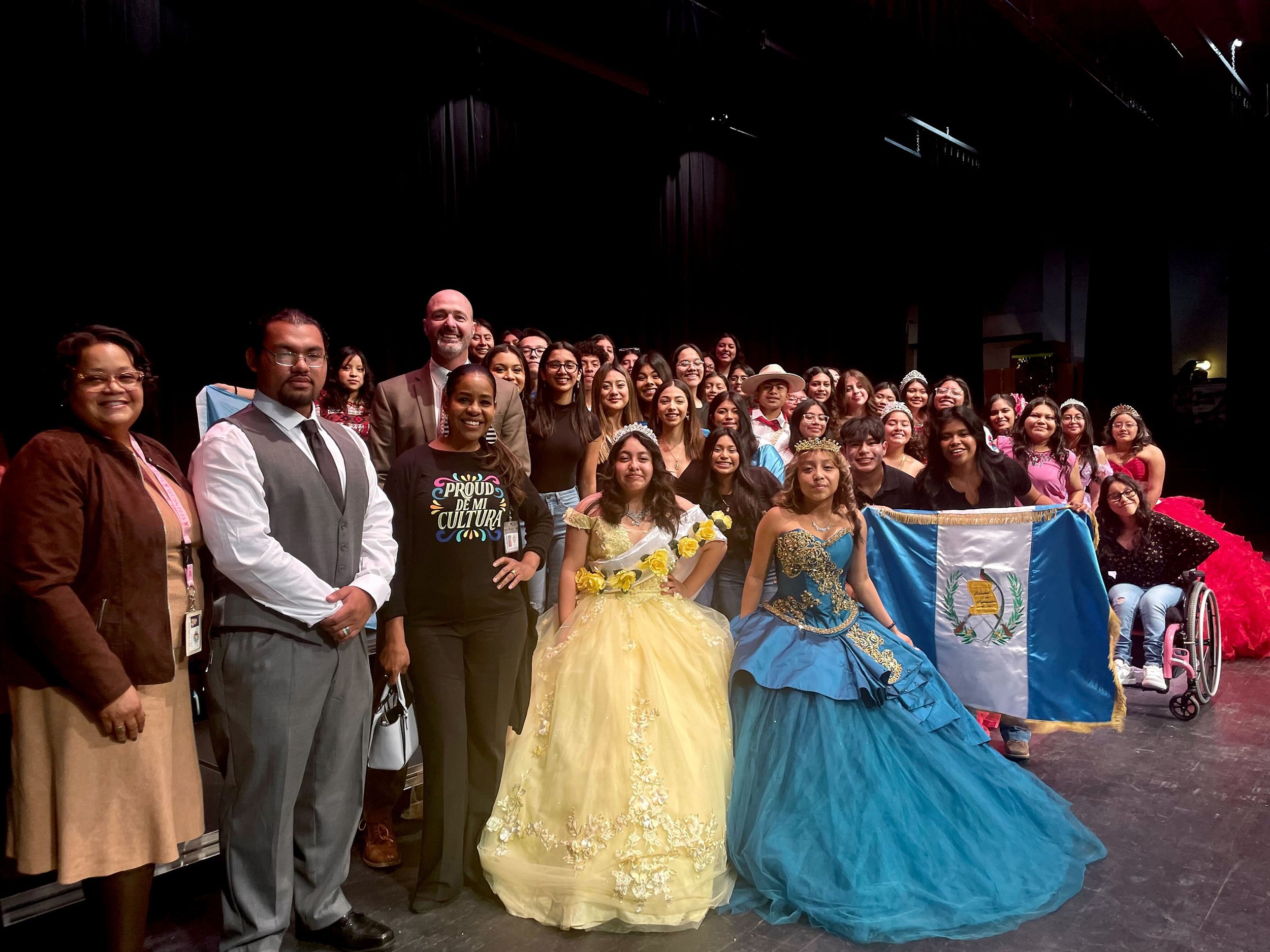
A Hispanic Heritage Month event that Grimes started in Russellville High School has now grown into a , where students learn about different cultures and traditions, perform dances, read celebrated authors and research historical figures. But a soccer program Grimes started has received perhaps the biggest response. Students had lobbied for the program before Grimes’ arrival with no success, but he understood that it was a beloved and important part of Latin American culture. “They wanted something that was theirs,” he said.
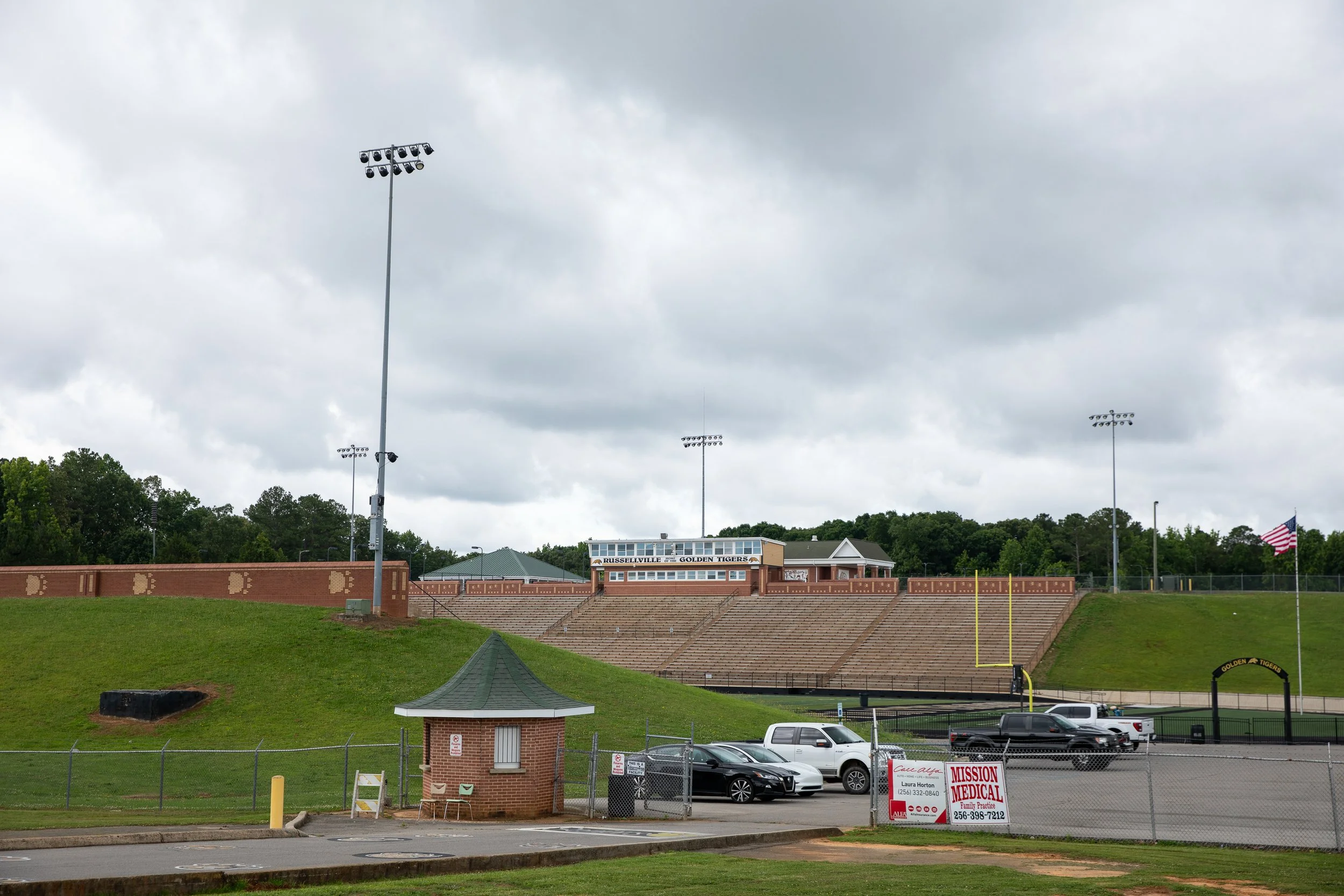
He didn’t have funds for a new soccer field, so he had the football field re-turfed, and students began playing in 2017. In 2021, when the Russellville Golden Tigers soccer team played in the state semifinals, both Hispanic and non-Hispanic families turned out in droves. “Everyone was cheering, ‘Sí, se puede,’ ‘Yes, we can,’” recalled Grimes when we met in his office this March. The school’s logo is a torch like that on the Statue of Liberty, and there’s a school tradition of holding up clenched fists to show unity and pride. “The whole Latino community stands up with their torches raised,” he added, “and they’re chanting, ‘Russ-ell-ville, Russ-ell-ville.’ That was very, very powerful.”
Grimes’s office wall was decorated with sports trophies from events like these, along with framed academic credentials including his doctorate degree. He was the first in his family to attend college. There were also photos of his family and past students, along with a well-worn Bible on his desk.
Batchelor, the former school board president, says that, while the process was sometimes challenging, through Grimes’ sustained efforts and example, families of all backgrounds gradually saw that improving the outcomes of English learners meant that the entire school system was better. “I think the community has embraced the fact that there’s room for all of us,” he said.
Not all of Grimes’ ideas worked. Early on, he separated English learners from other students during academic classes, but scrapped it after teachers told him it wasn’t working. Now schools do a combination of teaching English learners in small groups and with the entire class. After a back-to-school event took hours longer than expected because he asked for every sentence to be interpreted, Grimes decided to hold separate but simultaneous school meetings, where parents could choose to listen in Spanish or English.
And it hasn’t been easy to sustain all of the gains. Between 2019 (when the bilingual aides were hired) and 2021, English learners in some grades recorded big increases on language proficiency tests. For example, proficiency levels for second graders went from 46 to 84%, and for third graders, 44 to 71%. But the growth since then hasn’t been consistent, and proficiency levels in 2023 for some grades fell below 2019 numbers. Administrators say that is because the number of English learners continues to increase while the number of educators has not, so children are receiving less individualized attention.
But the goodwill Grimes generated from embracing Hispanic families has paid off in unexpected ways. In 2018, the district needed roof work on school buildings but didn’t have the money to complete it, Grimes said. Someone in the Latino community called Grimes, he said, offering to do the work for free. “They volunteered their time, their efforts, their energy and their materials, and they completed those buildings,” he told me.
Today, Latino businesses dominate the downtown area of a few blocks, which until recently was full of deteriorating, vacant buildings. There are three Mexican bakeries, two Latin grocery stores, three barber shops, nail salons and a ³¦²¹°ù²Ծ±³¦±ð°ùí²¹, or butcher shop. Business owners make it a point to support the school system, said Yaneli Bahena, who graduated four years ago from the Russellville school district and now owns a business called The Ville Nutrition.
A Mexican restaurant catered a 200-person back-to-school event, bakeries often donate bread and treats, and some salons provide free haircuts before school starts. The soccer field is ringed by banners from local Hispanic businesses that have sponsored the team. Bahena herself sponsors meals for school events and donates backpacks and school supplies. “School gave me a sense of hope,” she said. “I had really good teachers. Everyone cared about me.” In high school, she noticed that, unlike in years past, the students were included on field trips and encouraged to take electives. Bahena said some of her classmates stayed in school instead of dropping out to work because educators “pushed help.” She, too, credited Grimes: “Everything they put into these kids would not be possible without the superintendent.”

ADVOCATING STATEWIDE
In 2019, eager to find partners and support for his work with English learners, Grimes began chatting with other district leaders facing similar challenges and discussing what it would look like to advocate for those students statewide. Nationally, about are English learners and most of them speak Spanish at home. But even though most are U.S. citizens, they rarely get the support they need, in part because their education has become politicized, according to , a former superintendent and assistant U.S. secretary of K-12 education in the Obama administration. “People see the world (in terms of) a limited amount of resources. And so they feel, ‘if you’re giving them that amount, then you’re taking away from me,’” she said.
In part as a result of that attitude, experts say, reading and math scores for English learners nationally are among the lowest of all student subgroups, their lag behind, and they are less likely to go to college. “We need these kids and we need them educated,” said Patricia Gándara, co-director of the Civil Rights Project at UCLA and an expert on English learners. “They represent a very large part of the future of this country.”
The next year, in 2020, Grimes founded a coalition of superintendents called Alabama Leaders Advocating for English Learners, under the umbrella of a state operation, Council for Leaders in Alabama Schools. “His passion was evident and he was not going to stop,” said Hollingsworth of the School Superintendents of Alabama. “If you keep knocking on the door, knocking on the door, eventually somebody’s going to open the door. And that’s kind of what happened.”
The superintendents coalition led by Grimes successfully pressed the Legislature for more funding for English learners, to $150 per student, from about $50 to $75 in 2015. Districts with an English learner population above 10% receive $300 per student. For Russellville, that meant a fourfold increase to $400,000, at a time when city funding declined. Grimes received a for his “remarkable contributions and tireless advocacy for English Learner funding in Alabama schools.” Thanks in part to his advocacy, the state now has instructional support for districts, 12 coaches and a state director of English learning. Grimes also advocated for English learners’ test scores to count on the state report card only after they’ve been enrolled for five years (approximately the time it takes for students to learn a new language). That law, , went into effect last year.
Barnett of the Guntersville City Board of Education said Grimes’ efforts with English learners helped persuade other district leaders that they could do the work too. “Russellville is a great place, but there’s nothing special there that it can’t happen anywhere else,” he said. “There’s nothing in the water. It certainly can be replicated.”

For seven years, Grimes and the Russellville school board worked well together, he and former board members said. But discontent among other city leaders surfaced early on, several people told me. Grimes had started to clash with the city’s mayor, David Grissom, who was first elected in 2012, about funding. A Russellville resident close to the workings of city government who asked not to be identified for fear of retaliation says Grimes had angered Grissom and some City Council members early on when he noted publicly that his schools budget was $200,000 less than that of his predecessor. (McDowell, the school board lawyer, wrote in his email to me that Grimes was made aware of this cut after he took office and had agreed to it.) City Council members “did not take kindly to having their feet held to the fire or being made to look bad. So from then on, Grimes was marked,” the resident told me. Grimes also angered Grissom when he declined to publicly support the mayor’s choice for a City Council seat in 2020, preferring to stay neutral, several people told me.
In his response to me, Grissom did not comment on those specifics but wrote that he “had interviewed and have been interviewed by several hundred people of all races and ethnicities” about Grimes’ performance and that some of those he spoke with were dissatisfied with the superintendent. He posed questions about whether Grimes had been in his office every day, treated employees differently, and spent too much district money on conferences. Grimes said that he sometimes traveled around the state for his work, that the conferences were for professional development and approved by the board, and that as a leader he did sometimes have to make decisions that displeased people because he was weighing different perspectives and needs. He said he was shocked by the mayor’s statements because neither the mayor nor anyone else had previously brought such concerns to him. Gist and Batchelor, the former school board members, said they had never heard any such concerns from anyone in their roughly eight years of working with Grimes. “Not one word,” said Gist. Grimes’ personnel file did not contain any information indicating concerns with the superintendent’s performance. Neither the mayor nor the school board lawyer would provide any clarification about why, if such complaints existed, Grimes was not notified.
As Grimes continued to invest in efforts to help English learners, their numbers rose every year, doubling in size during his tenure, to 33%. After the 2020 City Council election, in an effort widely seen as intended to remove Grimes as superintendent, Grissom and City Council members began replacing members of the appointed five-member school board that had supported Grimes. (In his email, Mayor Grissom wrote that the council has the right to replace board members and had done so prior to Grimes’ tenure as well.) In May 2023, Greg Trapp, the school board member, informed the superintendent they would not renew his contract when it expired the following year.
Gist, the former school board member, said that while he was shocked at first by the City Council’s decision to replace him and others, it made sense given the Council’s antipathy toward Grimes. “That’s small-town politics. In order for them to control the system, they had to get rid of the school board members that were doing it right,” he said, adding: “That’s the only way they could remove him.” What upset him was knowing the decision wasn’t driven by what was best for students. “If they wanted to replace me with somebody better, that is fine,” he told me. “But when they did it for a personal reason, that bothered me.” (I reached out to Trapp at least three times, as well as to other board members, and they did not respond to my requests for comment.) Batchelor, who was replaced soon after he voted in favor of keeping Grimes, also said the board’s majority decision was a mistake: “I think he’s the best superintendent in the state of Alabama.”
In March 2024, the district named a new superintendent, Tim Guinn, a former Russellville High School principal, who was also a candidate for the superintendent position when Grimes was chosen. Most recently he’d worked as superintendent of the Satsuma district. Guinn did not respond to repeated interview requests.

PROGRAMS UNRAVELING
Already, some of the programs and practices Grimes put in place appear to be unraveling. As of June, most of the bilingual aides, whose salaries are paid for by pandemic aid that expires in September 2024, had not been rehired. In addition, some bilingual teachers did not have their contracts renewed. The board has not indicated if it has plans to move ahead with improvements Grimes planned for middle and high school English learners. A dual-language immersion charter school, which Grimes had advocated for and the board had approved, was set to open in 2025. It has been scrapped. (McDowell did not comment in an email on the district’s plans for English learners. Regarding the bilingual aides, he wrote that some of them were not rehired because the federal grants had expired. Grimes said he had planned to pay for their salaries using a combination of district reserves and funds he would save from teachers retiring: “You make decisions based on what your priorities are.”)
Grimes and the board had agreed for him to stay on until the end of the 2023-2024 school year as the district searched for a replacement. But a week after my March visit to Russellville, McDowell, the school board lawyer, accused him of intimidating people into talking to me, according to Grimes, and told the superintendent that he could not be on school property or speak to district employees unless it was in his capacity as a parent. At that time, Grimes stepped down from the day-to-day responsibilities of his job, but he will remain in the community while his 14-year-old daughter finishes high school. His wife also remains a teacher in the district. (In an email and in an interview, McDowell, said that he had never accused Grimes of intimidating anyone nor banned the superintendent from school grounds.) Also after my visit, more than a dozen educators I spoke with in Russellville told me that they were no longer comfortable being identified for fear of losing their jobs. The Hechinger Report/palabra agreed to delay publishing this piece until Grimes received his last paycheck on June 30.
In July 2024, Grimes started a full-time position with Reach University, the nonprofit that trains the bilingual aides as teachers, as its regional director of partnerships in Alabama, Mississippi and Tennessee.
The past six months have taken a toll. Grimes has said little publicly about his departure and has told most people in the community that he’s retiring. When we were having lunch together at a local restaurant, El Patron, other diners kept stopping by to wish him well. Two of them joked about how he looked far too young to retire. Grimes laughed and played along, but after they left, his shoulders slumped and he blinked away tears.
“I’ve spent my career very invested, very committed to doing what was best for kids,” he told me quietly. “I didn’t feel like I deserved for it to end this way.”
He said he doesn’t regret the changes he made for English learners in the city. “Jesus loved the people that everybody else didn’t. And that was part of his message — you love your enemies, you love your neighbors, you love the foreigners, you love the sinner,” he said. “I see God in those children.”
Rebecca Griesbach of contributed reporting.
This story about Russellville schools was produced by , an initiative of the National Association of Hispanic Journalists, and , a nonprofit, independent news organization focused on inequality and innovation in education, along with .
Did you use this article in your work?
We’d love to hear how ÉçÇøºÚÁÏ’s reporting is helping educators, researchers, and policymakers.