
;)
Education news and commentary, delivered right to your inbox.
Sign up for 社区黑料 newsletter.
Get stories like this delivered straight to your inbox. Sign up for 社区黑料 Newsletter
N.C. Reconnect, a pilot initiative to recruit adult learners at five North Carolina community colleges, will expand to five more schools this spring. MC Belk Pilon, president and board chair of the , announced during the November State Board of Community Colleges meeting that , , , , and will join the adult learner initiative.
鈥淭here is a lot of excitement in this room,鈥� Board chair Burr Sullivan said.
N.C. Reconnect started with five schools: , , , , and . The initiative focused on intentional outreach to adult learners and helped identify specific strategies to support them.
Working with InsideTrack, the five colleges called, texted, and emailed the 12,000 individuals who had completed at least 50% of a degree or credential.
The initial message was simple.
鈥淵ou can get a better skill and a better job,鈥� said Mike Krause, outside senior advisor to the John M Belk Endowment.
EdNC reported on the adult learner initiative in September. You can read the series
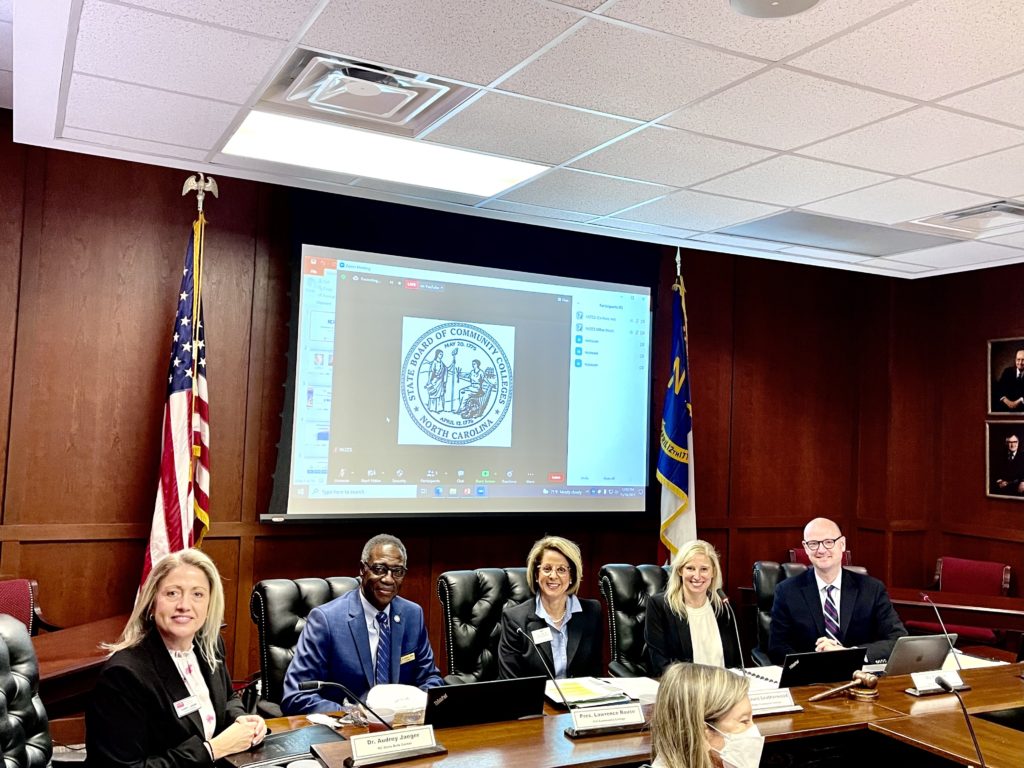
During Thursday鈥檚 issues luncheon, Board members heard from several individuals engaged in the N.C. Reconnect initiative. Presenters and panelists included: Belk Pilon, Krause, Dr. Audrey J. Jaeger, executive director of the Dr. Laura Leatherwood, president of Blue Ridge Community College, Dr. Lawrence Rouse, president of Pitt Community College, and , R-Alleghany.
The results of the pilot include nearly 1,000 adult learners enrolled across the five pilot schools. Blue Ridge Community College had the highest enrollment this fall in their college鈥檚 history, with an increase of 9% in total enrollment and 13% in FTE (full-time equivalent).
Even more surprisingly, the effort saw a 7% yield of cold calls. In many instances, a 2% yield would have been good news, Krause said.
鈥淲e called folks engrossed in the middle of their life, not even thinking about college, and they are students at these campuses as we speak,鈥� Krause said.
In addition to calls, texts, and emails, the John M Belk Endowment funded a $700,000 digital marketing ad campaign, which according to Krause is pretty modest. The ad campaign yielded 3.7 million unique views.
But getting students to campus is only part of the battle. Retaining them is the other.
鈥淲e now have all these students in our classrooms 鈥� I was thinking more about getting them in the door, but now I need to think about how my faculty interact with these adults,鈥� said Leatherwood. 鈥淚鈥檝e got to scale this across my whole institution.鈥�
Leatherwood and Rouse shared how their colleges have implemented supports for adult students.
Pitt opened a center dedicated entirely to adult learners. Individuals in the center are trained to work with adult learners and assess the needs of the students who walk through the doors. The adult learners also receive mentorship from trained staff.
鈥淲e provided a specific hotline for adult learners so that they could ask the questions and have the specific answers that they need,鈥� Rouse said.
The college is also out in the community, teaching classes at the detention center and using a mobile enrollment vehicle and mobile classroom.
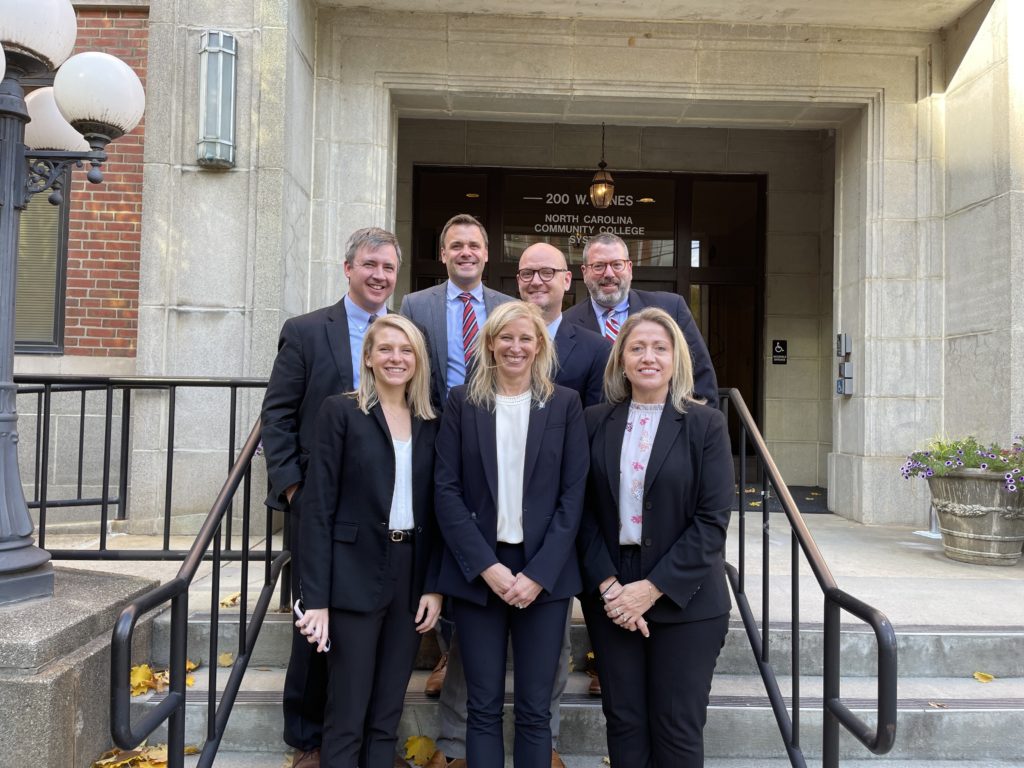
Leatherwood said Blue Ridge Community College hired success coaches, one in college transfer and the other in career and technical education. The coaches are tasked with checking in with adult learners throughout the academic semester.
鈥淲e assigned 497 adult learners this fall to a success coach. And as of yesterday, I have a 95.18% persistence rate for the semester,鈥� Leatherwood said.
Moving forward, Leatherwood and Rouse said they plan to start messaging to students much sooner.
Leatherwood said as leaders of institutions, they must change the culture of their organizations. That means reinventing themselves, building capacity, realigning resources, and creating more partnerships.
Near the end of the presentation, Krause shared a lesson he had learned from watching the five presidents as they navigated the initiative.
REACH Collaborative
Two dozen North Carolina community colleges are participating in another effort to recruit and retain adult learners.
In September, the Lumina Foundation announced a national effort to support adult students of color. The Racial Equity for Adult Credentials in Higher Education (REACH) Collaborative will acknowledge and address the educational pathway needs and lived experiences of adult students of color, according to a .
North Carolina is one of six states asked to join the collaborative, with 24 community colleges participating.
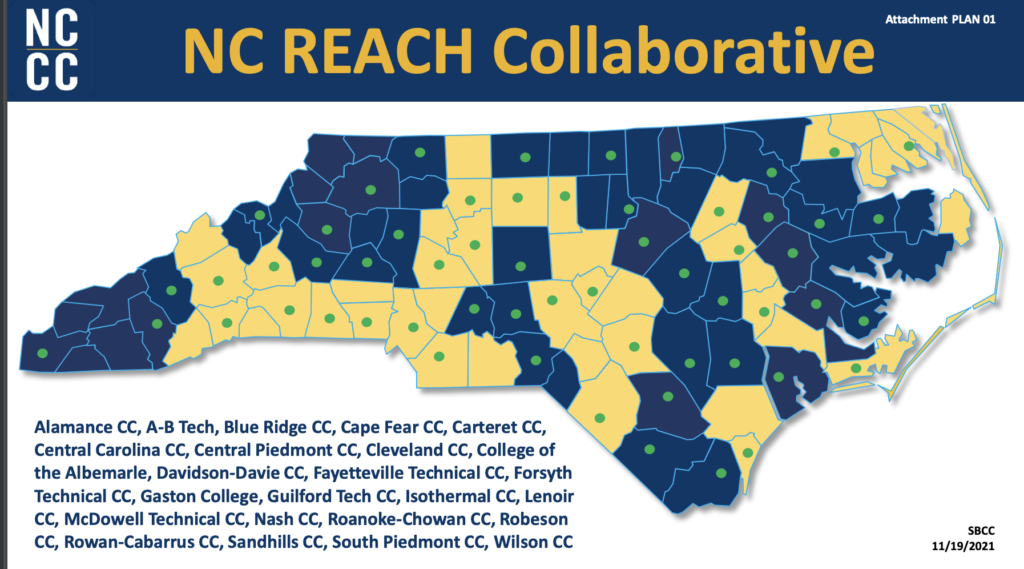
The project goal is a 2% increase in credential attainment for enrolled Black, Hispanic, and Native Americans at participating colleges by 2023.
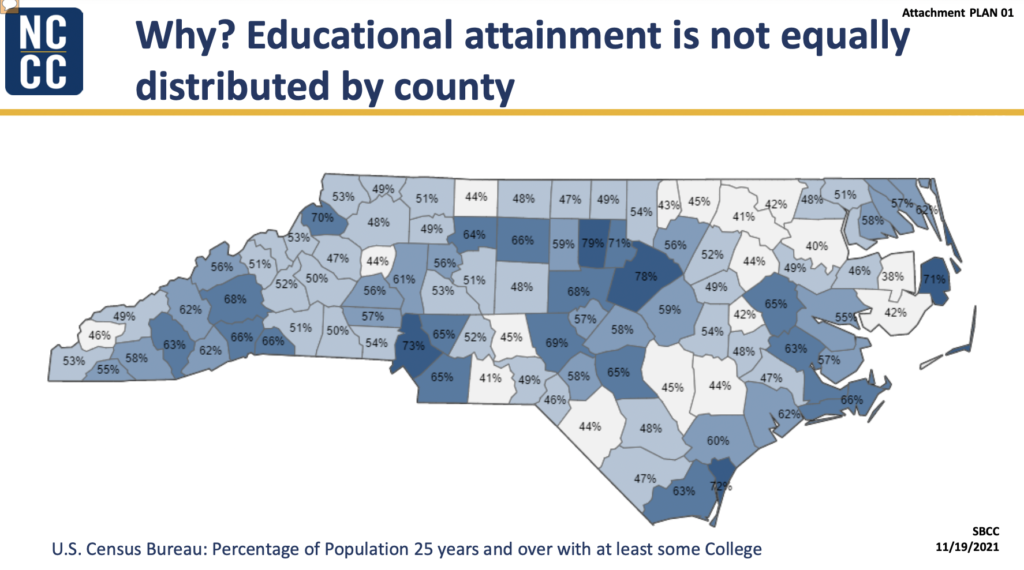
Dr. Patrick Crane, vice president of strategic initiatives at the , shared that educational attainment in North Carolina is not equally distributed by county, nor is it equally distributed by race/ethnicity.
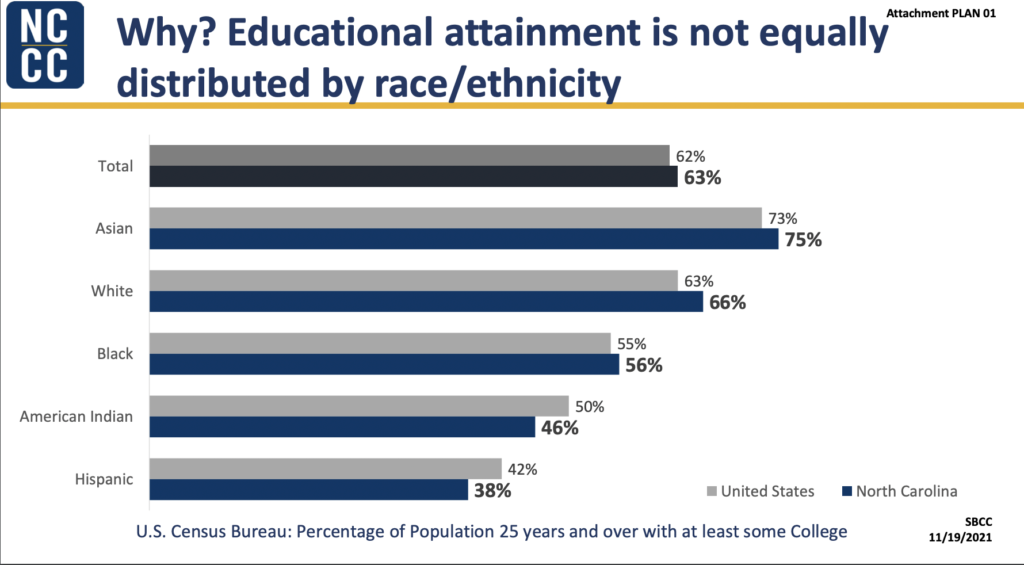
Crane mentioned the delivered by Broward College president Gregory Adam Haile. Haile described how Broward College identified six zip codes with the highest unemployment rates and the lowest education rates. Those six zip codes became a major focus for Broward College. Crane said there are valuable lessons to be drawn from that as they begin the work of this initiative.
REACH will help community colleges create pathways to high-quality non-degree credentials that are embedded in associate degree programs. Doing so will allow students to pursue better employment opportunities as they continue to work on a degree.
Colleges will also embed academic, financial, and wraparound student supports that will specifically account for the needs of adult students of color.
There is a total of $840,000 for this work. The Lumina Foundation provided $440,000 and the John M Belk Endowment became a co-founder in North Carolina and provided $400,000.
Community colleges get majority of priorities funded
November’s State Board meeting also featured a discussion of the recently-signed budget. Gov. Roy Cooper into law on Thursday, Nov. 18.
In his address to the Board, North Carolina Community College System president Thomas Stith said now was a time to be thankful, not only for the legislative achievements but also for how they came together as a community college family.
鈥淚t was a historic year,” Stith said. “The community college system has not received, at least over the last 10 years, this level of financial investment.”
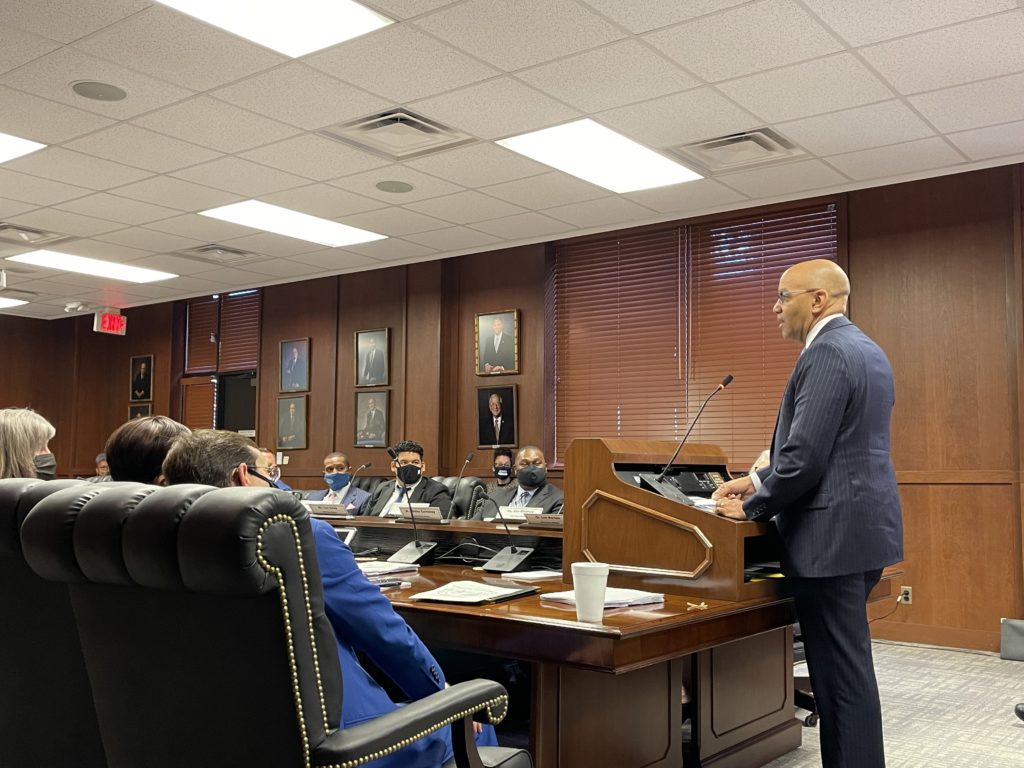
Presidents and Board members agreed that this budget was a win for community colleges.
鈥淐ommunity colleges certainly fared fairly well,鈥� said Dr. Mark Poarch, president of Caldwell Community College and Technical Institute. 鈥淢ost of our legislative priorities are funded.”

The net appropriation for the community college system is more than $1.3 million in both years of the biennium.
The a salary increase of 5% for community college personnel. The increase is 2.5% in the first year and another 2.5% in the second year.
In addition to salary increases, the budget gives just over $8.6 million in the first year and $12 million in the second year to create a fund to recruit and retain faculty in high-need areas. According to Stith, this will be the first time the community college system has received this type of funding.
The system asked for $60 million to stabilize community college budgets because of enrollment declines due to COVID-19. The signed budget includes almost $80 million in non-recurring funds for budget stabilization.
There is also $2 million in the first year to support the efforts of community colleges as they continue to serve adult learners. Ballard said she added the $2 million to help coordinate the efforts that were already underway.
Dr. Dale McInnis, president of , works with the Presidents Association legislative committee. He told Board members that they are not taking their foot off the gas. He said the budget was a great victory, but there is still more work to be done.
鈥淲e are going to have a survey conducted of all colleges so that we can quantify and capture salary needs to back and support our case for additional funding to build on the success we鈥檝e had in this budget in the next three years,鈥� McInnis said.
The next State Board meeting is scheduled for Thursday, December 16, 2021 and Friday, December 17, 2021 in the Dr. W. Dallas Herring State Board Room located in the Caswell Building in Raleigh, NC.
This first appeared on and is republished here under a Creative Commons license.
Did you use this article in your work?
We鈥檇 love to hear how 社区黑料鈥檚 reporting is helping educators, researchers, and policymakers.